
Posted on 5th Sep 2026
Traditional capacitor banks and Automatic Power Factor Correction (APFC) panels have been widely used for improving power factor in industrial electrical systems. However, modern manufacturing facilities increasingly operate with rapidly changing loads, variable frequency drives, welding machines, compressors, HVAC systems, CNC equipment and automated production machinery. These dynamic loads can make conventional step-based capacitor correction less responsive and less precise.
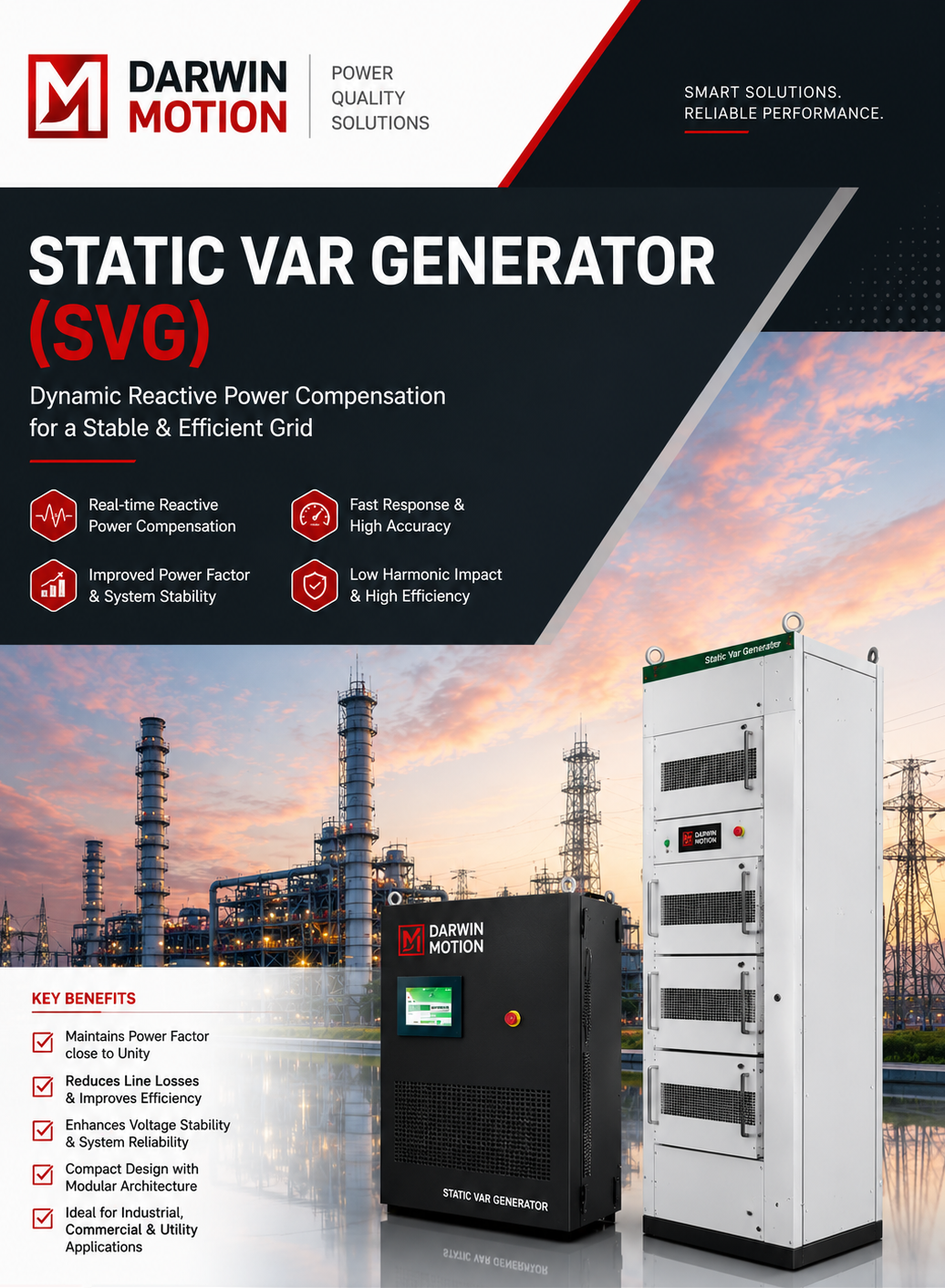
This is where Dynamic Capacitor Replacement technology provides a modern alternative. A Static VAR Generator (SVG) can deliver continuous and stepless reactive power compensation, dynamically responding to changing electrical demand. Darwin Motion, an AC Drive manufacturer and power-quality solutions provider, offers SVG technology designed for modern industrial and commercial electrical networks.
Conventional capacitor banks generally compensate reactive power by switching capacitor stages in and out according to the measured power factor. This approach can work effectively when electrical loads remain relatively stable. However, industrial loads can change within seconds or even milliseconds.
For example, a manufacturing facility may simultaneously start motors, vary VFD speeds, operate welding equipment and switch production machinery. The reactive power requirement can therefore change continuously.
When a conventional capacitor bank cannot follow these variations accurately, the system may experience under-compensation, over-compensation or unnecessary capacitor switching.
Dynamic Capacitor Replacement refers to replacing, supplementing or modernizing conventional capacitor-based reactive power correction with a power-electronic solution capable of continuously responding to reactive power demand.
Instead of relying on multiple fixed capacitor stages, a Static VAR Generator uses power electronics to inject or absorb reactive current according to real-time system requirements.
Darwin Motion's SVG uses high-speed IGBT technology and intelligent DSP control to dynamically provide leading or lagging reactive power compensation. According to Darwin Motion, the system can respond within approximately 5 milliseconds and provide power factor correction up to 0.99 under specified conditions.
A Static VAR Generator continuously monitors the electrical network and determines the amount and direction of reactive power required. Rather than switching fixed capacitor steps, the SVG electronically generates the required compensating current.
This continuous operating principle makes SVG technology particularly suitable for facilities where reactive power demand changes frequently. Darwin Motion describes its SVG as providing continuous, stepless and real-time compensation rather than fixed-step correction.
The biggest difference between an SVG and a conventional APFC capacitor bank is the way reactive power is controlled. APFC panels typically switch capacitor stages according to preset steps, while an SVG electronically adjusts its compensation output.
| Parameter | Dynamic SVG | Conventional APFC |
|---|---|---|
| Compensation Method | Continuous and stepless | Fixed capacitor stages |
| Response | Millisecond-level dynamic response | Slower step-based switching |
| Switching | No conventional capacitor switching | Contactors or switching devices |
| Load Variation | Suitable for rapidly changing loads | Best suited to relatively predictable loads |
| Over-Compensation | Dynamic control minimizes unnecessary compensation | Possible during changing load conditions |
| Maintenance | Low-maintenance power-electronic system | Periodic capacitor and switching-system maintenance |
Darwin Motion's published comparison highlights real-time compensation, approximately 5 ms response, continuous compensation and the absence of conventional capacitor switching as advantages of its SVG technology.
Unlike fixed capacitor steps, an SVG can continuously adjust its reactive power output. This enables compensation to follow actual electrical demand instead of relying on predefined capacitor stages.
Industrial machinery can create rapid changes in reactive power demand. Darwin Motion specifies a response time of approximately 5 milliseconds for its SVG, enabling rapid compensation during dynamic operating conditions.
Maintaining a higher power factor reduces unnecessary reactive current in the electrical network. Darwin Motion specifies power factor performance up to 0.99 for its SVG under applicable operating conditions.
Reactive power variations can influence voltage conditions within an electrical network. Dynamic compensation can help stabilize the system when electrical loads change rapidly.
Reducing unnecessary reactive current can help lower I²R losses in transformers, cables and distribution equipment. This can contribute to better utilization of the existing electrical infrastructure.
When reactive current is reduced, more of the available transformer and cable capacity can be used for useful active power. This can be especially valuable in facilities operating close to their electrical capacity.
Because an SVG uses power-electronic compensation rather than conventional capacitor-stage switching, it can avoid the frequent mechanical switching associated with traditional APFC arrangements.
Dynamic compensation is particularly useful in facilities where production equipment is frequently switched on and off or where motor speeds vary throughout the production cycle.
Dynamic reactive power compensation can be considered across a wide range of industrial, commercial and infrastructure applications. Darwin Motion lists manufacturing, automotive, steel, cement, textile, pharmaceutical, chemical, water and wastewater, HVAC, data centers, renewable energy and other sectors among SVG applications.
Production facilities often operate several motors, VFDs, compressors, welding machines and automated systems. The resulting reactive power demand can change according to production requirements.
Large motors and rapidly changing industrial processes can produce significant variations in electrical demand. Dynamic compensation can help maintain a more stable power factor.
Textile plants use numerous motors, drives, fans, pumps and production machines. Since production loads may vary throughout the day, continuous compensation can be advantageous.
Welding machines, robotic systems, compressors, conveyors and motor-driven machinery can create constantly changing electrical conditions. SVG technology can dynamically respond to these variations.
Large commercial facilities can experience changing loads as chillers, pumps, air-handling systems and other HVAC equipment cycle according to demand.
Data centers require highly reliable electrical infrastructure. Dynamic power-quality solutions can support efficient utilization of electrical distribution systems where load profiles change with operating conditions.
Variable Frequency Drives are extensively used for controlling motor speed and improving process efficiency. However, facilities with large numbers of drives may also require careful power-quality management.
When VFD-driven motors, compressors, pumps and fans operate at different speeds, the electrical demand can vary significantly. A conventional capacitor bank may not always track these changes smoothly.
An SVG provides a dynamic approach by continuously adjusting reactive power compensation according to the instantaneous requirements of the electrical system.
Darwin Motion is an AC Drive manufacturer providing industrial drive and power-quality technologies. Its portfolio includes Variable Frequency Drives, Servo Drives, Static VAR Generators, Active Harmonic Filters and other advanced electrical solutions.
The company's SVG technology is designed around high-speed IGBT power electronics and intelligent DSP control. Its published product information includes continuous reactive power compensation, voltage stabilization, automatic load detection and three-phase load balancing.
Darwin Motion's published SVG specifications cover a broad range of industrial electrical applications. The system is specified for 208V–690V AC networks, with compensation capacities from 30A to 600A depending on configuration.
In many applications, an SVG can replace conventional capacitor banks as the primary reactive power compensation solution. However, the appropriate architecture depends on the site's electrical characteristics, load profile, required compensation capacity, existing infrastructure and power-quality objectives.
Darwin Motion also states that its SVG can work alongside conventional capacitor banks where a hybrid approach is appropriate.
A facility may consider moving from conventional capacitor correction toward dynamic SVG compensation when its electrical system experiences rapidly changing loads or when traditional APFC equipment does not provide the desired power-factor performance.
Replacing a conventional APFC system should begin with an assessment of the site's electrical conditions. Rather than selecting equipment solely according to transformer capacity, engineers should evaluate the actual reactive power profile and operating conditions.
Review transformer ratings, feeder configuration, major loads, existing capacitor banks, VFDs and other power-electronic equipment.
Record power factor, kVAR demand and load variation during different production conditions. This helps establish the actual compensation requirement.
Identify problems such as frequent switching, capacitor failures, insufficient correction or over-compensation.
Select the appropriate SVG capacity based on measured reactive power demand and the desired operating margin.
The SVG should be integrated into the electrical distribution system according to the site's protection, switching, cable and transformer arrangements.
After installation, power factor, reactive current, voltage conditions and overall electrical performance should be monitored to verify that the system is achieving the intended results.
Power factor improvement does not directly reduce the active energy consumed by every load. However, reducing unnecessary reactive current can reduce electrical losses in distribution equipment and improve the utilization of transformers and cables.
For facilities where low power factor results in utility penalties or additional demand-related costs, maintaining a consistently high power factor can also provide financial benefits, subject to the applicable electricity tariff and utility rules.
The electrical requirements of modern industries are becoming increasingly dynamic. Conventional capacitor banks can remain useful in appropriate applications, but rapidly changing loads often demand a faster and more precise approach to reactive power compensation.
Dynamic Capacitor Replacement using Static VAR Generator technology provides an advanced alternative to conventional step-based capacitor correction. With continuous compensation, fast response, intelligent control and the ability to dynamically address leading and lagging reactive power, SVG technology can help modern facilities achieve improved power-factor performance and electrical-system stability.
Darwin Motion, an AC Drive manufacturer and power-quality solution provider, offers Static VAR Generator technology for industrial, commercial and infrastructure applications. Its published SVG solution combines high-speed IGBT technology with DSP-based control to provide dynamic reactive power compensation for changing electrical loads.
For facilities looking to modernize conventional APFC systems, reduce dependence on capacitor switching and achieve more responsive reactive power management, Dynamic Capacitor Replacement with Darwin Motion SVG can be considered as a next-generation power-quality solution.
Dynamic Capacitor Replacement refers to replacing or supplementing conventional capacitor-bank-based reactive power correction with a dynamic power-electronic solution such as a Static VAR Generator.
Yes, an SVG can replace conventional APFC equipment in many applications. It can also operate alongside capacitor banks where a hybrid compensation strategy is preferred. The appropriate solution should be determined from the site's electrical conditions.
The primary advantage is continuous, stepless and rapid reactive power compensation instead of fixed-step capacitor switching. Darwin Motion specifies approximately 5 ms response for its SVG.
Yes. SVG systems are particularly relevant to facilities with dynamic loads such as VFD-driven motors, compressors, HVAC systems, welding equipment and automated machinery.
Applications include manufacturing, automotive, steel, cement, textile, pharmaceutical, chemical, water treatment, HVAC, commercial buildings, data centers, renewable energy and other facilities with changing reactive power requirements.
Darwin Motion combines AC Drive expertise with power-quality solutions such as Static VAR Generators and Active Harmonic Filters. Its SVG platform is designed for dynamic reactive power compensation, voltage stabilization and improved power-factor performance in modern electrical systems.